Not On My Watch

Like most students, I arrived at college carrying the history I had been taught — tidy timelines, familiar heroes, and very little understanding of Indigenous lives or what sovereignty truly meant. At the time, that lack of exposure felt normal. I chose classes that fit the mold I was already in.
I was attending Mesa Community College in San Diego — an open campus with no real hallways, just walkways between classrooms, palm trees overhead, and the Pacific Ocean never very far away. In Southern California, learning happens outdoors. The air is warm. The sky stays open.
I loved my time there.
I was young, building a life, working full time for a government contractor, and trying to figure out who I was becoming. My first son would later be named Noah Kai — “peaceful ocean” — a name that came from those years living near the water in Ocean Beach, where even identity felt fluid and unfinished.
When it came time to choose a history course, I barely looked past the familiar option — “U.S. History,” or something equally generic. It seemed like the natural choice.
On the first day of class, as the instructor reviewed the syllabus, I felt something quietly wrong in my body.
Sitting there, in a lecture that felt like high school continued, none of it resonated.
At the first break, I walked out.
Back in the open air, under that wide California sky, I opened the course catalog again and looked more carefully.
“Native American History.”
It met the requirement.
It fit my schedule.
Tuesday and Thursday — perfect for a full-time worker.
I enrolled without much thought.
Little did I know that this single decision would quietly change the course of my life…
and one day give me the language to write about a subject as sensitive — and as necessary — as this one.
How did I get here to begin with?
It was early in high school — possibly even before that — that I knew I wanted to serve in the military. My grandfather had served during the Korean War, my father during Vietnam, and from my perspective it simply made sense. I had no idea what I wanted to do after high school. I only knew I didn’t want to sit in any more classrooms.

So I joined the Navy through a delayed enlistment program. While what was being broadcast across our polarized media at the time made me feel confident in the decision. The narrative was clear. The purpose felt obvious. Service, to me, meant alignment.
I was fortunate to be sent to San Diego for boot camp. And the first of many quiet revelations arrived early: no matter how far I traveled, I would always find myself back in a classroom — as long as I still wanted to learn.
I spent four years on active duty, stationed at Naval Air Station North Island. After that, I went straight to work for a government contractor just a stone’s throw from where I had served. I also joined the reserves, again right around the corner from both of those places. My professional life stayed familiar, structured, orderly — but it created space for something new.
It allowed me to begin higher education.
During those early years of service, I received several awards. One of them was the National Defense Service Medal — an honor only given during periods of global conflict. That distinction carried weight. With it came a deepened sense of responsibility, and a phrase that followed me everywhere:
Not on my watch.
It was said in training.
It was said among peers.
It became a quiet internal code.
But it wasn’t until one evening — sitting in a Native American History class — that those words would finally take on a meaning I had never considered.
A student asked the professor, almost painfully, “How do we live with ourselves when all these atrocities took place… and are still taking place?”
Without hesitation, the professor replied:
Not on my watch.
This time, it wasn’t spoken by a commanding officer.
It wasn’t part of military culture.
It came from a historian.
And something inside me shifted.
After that semester, I took the next one with the same instructor. Eventually I transferred to San Diego State University and chose to take yet another class with him. His courses were demanding — unrelenting at times — but they were also some of the most rewarding intellectual work I had ever done.
Through them, I became immersed in the depth and breadth of Indigenous contributions to what we now call North America.
And one example, in particular, never left me.
It is the reason I chose to write about this now.
The Code Talkers.
Across the war, machines like the Enigma were built to protect empires through layers of encryption no enemy was meant to penetrate. And yet, the most unbreakable code would not come from a machinelike this at all.
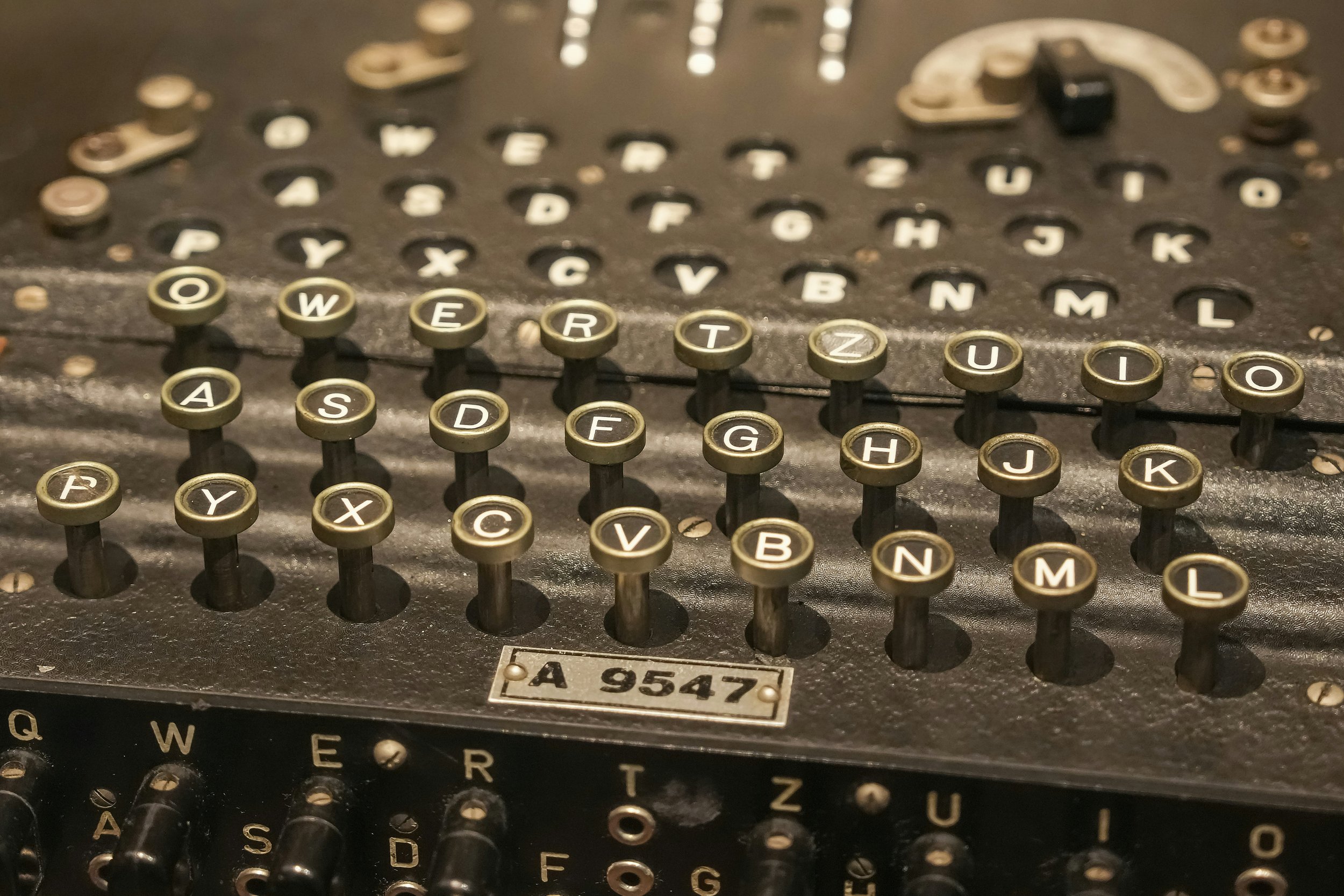
It would come from the spoken language of the Navajo Nation.
I had heard of them before that class — perhaps only in passing — but I had never truly understood the weight of what they represented.
During the Second World War, coded military communication was extraordinarily difficult. Messages were intercepted. Systems were broken. Intelligence was compromised. And in that vulnerability, the United States turned to something it had long tried to erase.
The spoken language of the Navajo Nation.
Men whose people had endured forced removals, boarding schools, and cultural suppression were now entrusted with safeguarding the most sensitive military intelligence of the war. Their language — known only within their community — became an unbreakable code.
And it worked.
Campaigns were coordinated. Lives were protected. Entire battles were shaped by voices speaking a language the enemy could not decipher.
History tells us this helped secure victory.
What history rarely pauses to ask is something else:
Who were we asking to save us?
And what did we owe them in return?
Even now, I struggle with the word “American” — how easily it includes Indigenous people when convenient, and how often it forgets them when reckoning is required.
The Code Talkers showed me something I had never seen so clearly before.
Service without surrender.
Obedience without erasure.
Participation without loss of identity.
They used the system — but they did not become it.
They protected a nation — without abandoning their own.
And for the first time, I understood sovereignty not as separation…
…but as integrity.
That, more than any battlefield story or military tradition, became my true understanding of “Not on my watch.”
Not as a slogan.
Not as obedience.
But as a personal ethical vow:
That I would pay attention.
That I would speak when silence becomes complicity.
That I would remember who stands inside every system we praise.
Because empires rise and fall.
But conscience is always a choice — even inside empires.

Speaking of empires rising and falling, we can go back much further.
Long before modern nations, long before flags and borders, peoples across Europe, Africa, and the British Isles — Druids among them — faced the expanding reach of the Roman Empire. Many of us romanticize the idea of defending one’s homeland against oppressors. It is an easy narrative to admire.
But at what point does defense become enforcement?
And how far can duty be taken before civil liberty is no longer part of the equation?
From the perspective of someone who once served, I came to understand how powerful a tool duty can become.
I was never placed in a position where I had to directly take another human life. But while working for a government contractor, I once received an award for replacing the engine–generator assembly of a crane that had to remain fully operational during flight operations aboard an aircraft carrier.
The job took place on a carrier docked in Bahrain.
When it was complete, I was airlifted off the deck and flown nearly four hours from somewhere over the Indian Ocean back to Bahrain, and eventually home to San Diego.
This all occurred in February, not long after the tragedy of September 11th had shaken our nation to its core.
While waiting for my flight home, I watched fighter jets launch fully loaded — and return empty.
I remember standing there, surrounded by steel and motion and heat, feeling something close to fulfillment. Pride, even. A quiet sense that I had done my part.
And then, much later, a question began to form.
Was I, in that moment, any different from a Roman soldier maintaining the machinery of empire?
How many lives depended on my work?
And how many were lost because of it?
Not by my hand.
But by my participation.
It brought back something Muhammad Ali once said in an interview — words that stayed with me long after I first heard them:
That he would never travel to another country to kill someone he would rather sit down and have a beer with.
For the first time, I understood that service does not only shape outcomes.
It shapes conscience.
Now I find myself asking a different question.
What does “Not on my watch” mean to you?
I have come to believe that my real work in this life is not to provide answers, but to ask better questions. And given the simple proof that history tends to repeat itself, I wonder:
How are you feeling today?
Not through your ancestors.
Not through your leaders.
Not through your employer.
Not through any inherited narrative.
But through you.
Through your own body.
Your own conscience.
Your own sense of right relationship with the world.
I am deeply grateful for the people who entered my life at precisely the right moments and helped align my perspective — not toward ideology, but toward discernment. Toward an understanding of how essential civil liberties are, not only to nations, but to individual nervous systems, to families, to communities, to futures.
Because when you strip away politics and history and labels, most of us — nearly all of us — agree on something remarkably simple:
That dignity matters.
That freedom matters.
That conscience matters.
And that systems work best when they protect what makes us human, not when they forget it.
For me, that is what “Not on my watch” finally came to mean.
Not obedience.
Not enforcement.
Not silence.
But presence.
And the quiet, ongoing choice to remain awake to the world I am helping to shape — simply by the way I choose to stand within it, awake, one small choice at a time.